About
Made by a ham, for the shack.
Who makes it
Costas is written by Tony, W7LIT, and published by Ember Ridge Development. Tony operates FT8 from grid DN40 on a Yaesu FT-710, and Costas started as a fix for his own station: a cleaner way to see who was worth calling, and transmit audio and keying that just worked.
It grew from there. Every feature has been tried against real band recordings first, and the on-air rules are strict: Costas never starts transmitting unless you asked it to, stops by itself if you walk away, and never changes a message without telling you.
Costas is free software under the GNU GPL. Bug reports and ideas are welcome on GitHub.
Where the name comes from
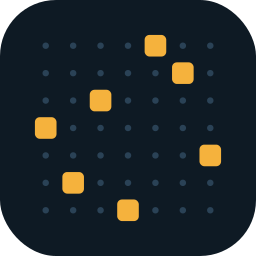
Every FT8 signal carries the same small pattern three times: at the start, in the middle and at the end of its 12.6 seconds. It is a Costas array, seven tones in the order 3, 1, 4, 0, 6, 5, 2, and it is how a decoder finds a signal in the noise, both when it started and exactly where it sits on the waterfall.
The pattern is named after John P. Costas, an engineer at General Electric who worked them out in the 1960s for sonar and radar and published them in 1984. Their trick is that no two pairs of dots are the same distance apart in both time and pitch. Slide a copy over itself and it only lines up in one place, so the match is sharp and hard to fool.
That is what Costas the program tries to do for you: pick out the stations that matter from a crowded band, quickly and without fuss. The pattern is also the app's icon.